
Lab / Concept
Application shell
Lilith: a dark launchpad that wears any brand
A planned dark-first, white-label application shell on Tauri 2, with skins, plugins, passkey admin and offline-first behaviour.
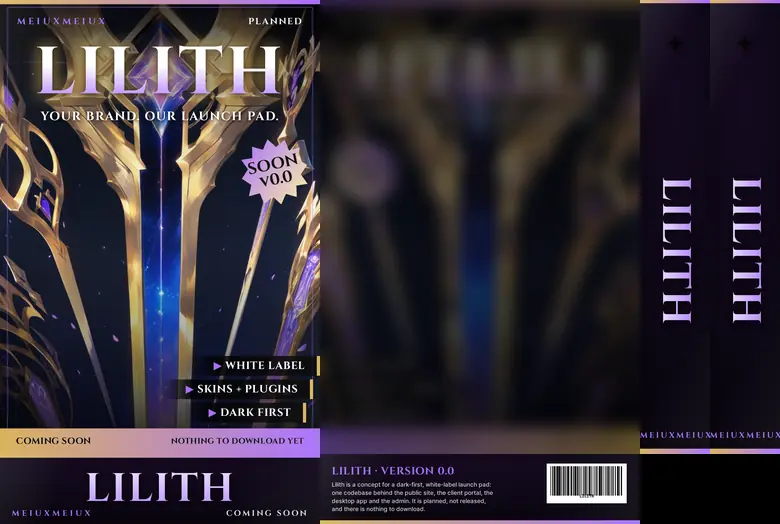

Drag the box to turn it
How the launchpad fits together
One small core. Skins on top. Plugins at the side.
The idea
Most desktop apps start as a blank window and slowly grow a settings page, a sign-in, an update check and a way to add features. A launchpad is that starting point made once and done properly: a small, fast application shell you open first, and from which everything else hangs. Lilith is that shell, designed dark first and built to be re-skinned for whoever ships it.
Why dark and white-label
- Dark first: the default look is built for long sessions, with light as the variant rather than the other way round.
- White-label: name, colours, icon and wording are data in a skin, not code, so one shell can carry a different brand without a fork.
- Plugins: features arrive as plugins that declare what they need, so the core stays small and a brand turns on only what it wants.
Why Tauri 2
The shell uses the system's own web view and a Rust core instead of bundling a whole browser, which keeps installers small and memory use low. Each window gets an explicit list of what it may touch. The longer argument is in the Tauri 2 essay.
Admin and offline
Sign-in to the admin side is by passkey first, with no password to leak. The shell is offline-first: it starts, shows your data and queues changes with no connection, and syncs when one comes back.
The entities it carries
The parts we kept rebuilding across projects now have names: guardians, gates, house organs and shared patterns. Each is shown on its own, with how it feeds Lilith, on the symphony page, where every card takes advice.
Status
Planned, not released. It is open core: parts are intended to be free and open source once they are done, with hosting and plugins offered alongside, and the licence is still to be decided. The code is private and there is nothing to download yet.
More from the lab
Other ideas on the bench.
 Essay · Desktop and mobile apps
The argument for Tauri 2
Read
 Concept · Agent protocol
JIVA: one terminal, many souls
Read
 Concept · Local-first AI
Iblis: the studio that runs on your own machine
Read
 Concept · Developer tooling
Bael: a thermal guardian for unattended builds
Read
 Concept · Agent tooling
Leviathan: borrow before you build
Read
 Concept · Multi-model reasoning
Delphieiux: ask once, a council answers
Read
 Concept · Music visuals
Vizeiux: a visualizer that reads the song first
Read
 Concept · Audio analysis
Audeiux: a second opinion on a finished mix
Read
 Concept · Music video
Videiux: a video maker that hears the song
Read
 Concept · Events
Bootheiux: one shell for interactive booths
Read
 Concept · Presentation
Software you can hold: honest 3D boxes
Read