

mecasasu.casa
A complete beginner's guide to renting a server, locking it down, and letting an agent build on it — served by the box it describes, with live telemetry to prove it.
mecasasu.casa is a single long-form guide that takes someone with no server experience from "I have a Windows laptop" to a hardened VPS running their own software on their own domain for about $45 a year — buying the box, closing the ports, keys instead of passwords, nginx + systemd + TLS, wildcard subdomains, a database per project, backups that have actually been restored, and how to drive a coding agent that has root on the thing. The proof is the site itself: it is served from exactly the box it teaches you to rent, and a companion page streams that box's live vitals — CPU, memory, disk, network, processes — read straight out of /proc by a small Go binary, sampled every two seconds, with no agent and no database anywhere in the path.
- Go
- JavaScript
- nginx
- systemd
- Ubuntu
- PostgreSQL
- Lucide
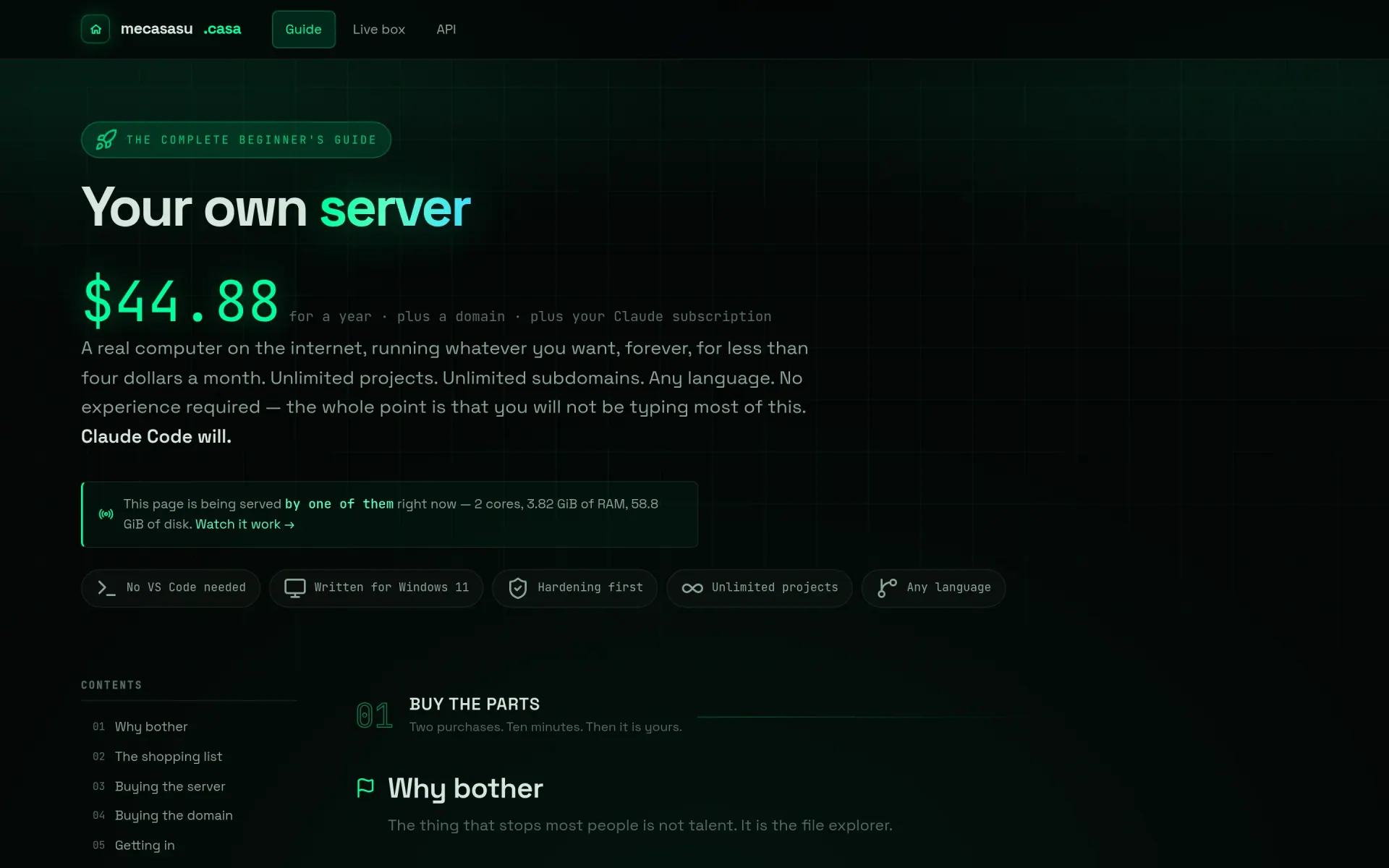
mecasasu.casa answers one question end to end: what does it actually take for someone who has never touched a server to own one, secure it, and put their own software on the internet from it? The answer it argues for is a $44.88-a-year VPS, a cheap domain, and a coding agent with a terminal on the box — and the guide is written on the premise that the reader will not be typing most of the commands themselves.
The argument
The opening section is the thesis: people stall out not for lack of talent but because they are supervising an agent through a file explorer on their own laptop, terrified of every suggested change. Rent a machine that isn't your laptop, give the agent real permission on it, and the hesitation goes away — because the blast radius is a box you can rebuild in ten minutes.
What it covers
- Buying the parts — which VPS tier is a false economy, where domains are sold at cost versus where the renewal price doubles, and what a year really totals.
- Locking it down before anything else: stop being root, keys instead of passwords, passwords off entirely, every port closed but three, automatic banning of scanners, unattended security upgrades — with a section on the things that actually go wrong when you do this.
- Working the agent — mounting the server as a drive so there is no editor in the loop, planning with one model and building with another, clearing context early and leaving a note, and auditing what the agent remembers.
- Shipping: project layout and the
boilerplate nobody remembers,
justrecipes worth having everywhere, GitHub without committing a secret, pointing DNS, nginx + systemd + TLS, infinite wildcard subdomains, a database per project, cross-compiling in Actions, code signing and what the warning screen costs to remove. - Backups that hold — 3–2–1, grandfather–father–son rotation, the four things worth backing up, and the line the whole section exists for: a backup you have never restored is a rumour.
The live box
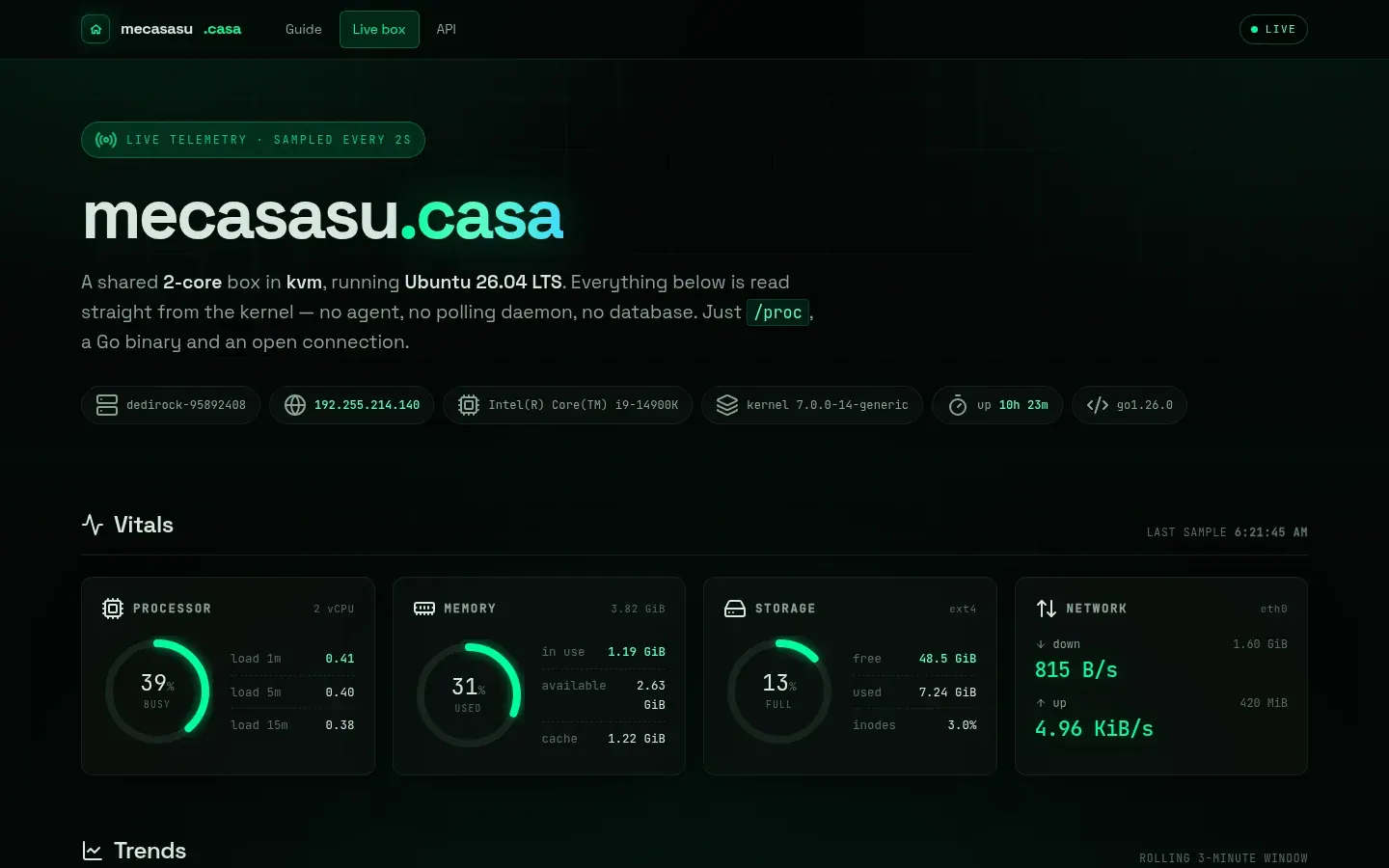
The claim "this page is being served by one of them right now"
is checkable. A second page streams the host's real telemetry —
processor and load, memory and swap, disk and inode pressure,
per-interface network rates, the actual process table, and
steal time, so a reader can see for themselves what a shared
core does under a noisy neighbour. It is read directly from
/proc by a Go binary and pushed over a single open
connection every two seconds: no monitoring agent, no polling
daemon, no time-series database. The page reports how many
people are watching it, which is itself part of the demo.
Delivery
nginx in front of the Go service, static assets stamped with a build version, and the same hardening the guide preaches turned on for its own domain — a strict content-security policy that allows exactly one third-party origin, HSTS, framing denied, referrer and permissions policies set, MIME sniffing off. The guide would be less convincing served from anything softer.
Gallery
The full set.
Build something like this
Want a tool like this for your shop?
We've shipped this kind of thing before. Twenty-minute intro call, no slides.