
Iblis
Free, open-source, local-first AI music workstation for Windows — an Electron shell with a hot-swappable plugin architecture.
Iblis is a free, open-source, local-first AI music workstation for Windows 11. It runs offline by default for generation, training, playback, library and skins — no account, ever — as an Electron shell where everything beyond text-to-song (stem splitting, BPM/key detection, waveform visualization, lyric help, skins) is a signed, hot-swappable plugin. The desktop app is GPL-3.0-or-later, the plugin SDK Apache-2.0 and the first-party plugins MIT; the source went public in September 2026. A product key is optional and only connects an install to the hosted community Styles services — publishing, downloads and uploads. Themes and skins are first-class and orthogonal to plugins, driven by a unified design-token vocabulary. In public beta and shipping: the Windows installer, signed auto-update channel, signed plugin host, generation engine, LoRA training, stem separation, skin system and track library are all live.
- TypeScript
- Electron
- Svelte
- Vite
- Python
- Rust
- essentia.js
- aubio
- PHP
- just
- GitHub Actions
- Windows 11




Iblis is a free, open-source, local-first AI music workstation for Windows 11. It is built to run entirely on the user's machine — offline by default, no cloud dependency, no account or sign-in, and no product key needed to generate or train. The application is an Electron shell with a deliberately small core; almost every capability is a plugin.
Plugin-first architecture
- The shell ships only text-to-song. Stem splitting, BPM/key detection, waveform visualization, lyric and song-idea helpers, the training pack and the engines themselves are all hot-swappable plugins against a strict plugin contract, installed from an Ed25519-signed catalog and rolled back atomically.
- Plugins and skins are orthogonal — skins never reach into plugin logic and vice versa.
- Skins are first-class. Four ship by
default —
dark-3d(the default, red/blue lens styling),light-paper,infernal, andcathedral— all expressed through a single shared design-token vocabulary so themes are live-swappable without touching component code, and an in-app token editor lets anyone cut their own.
How it's wired
The workstation is strict TypeScript on
Electron 44, with a Svelte 5 +
Vite renderer that never touches the network or
the filesystem — it talks to the main process over typed IPC
only. Audio analysis runs in-process via
essentia.js and aubio for
tempo and key detection (four detectors ship; every result names
the one that produced it); the shipped generation engine is
ACE-Step 1.5 running as a native C++/GGML
sidecar (acestep.cpp), which the shell talks to
through a neutral engine-provider interface that keeps ACE's own
HTTP dialect confined to an explicit compatibility driver — so a
second engine can plug in without leaking ACE's quirks into the
host. Stem separation is a Rust sidecar running
three Demucs models on the GPU through Vulkan, and
Python is confined to an isolated, opt-in LoRA
training-pack sidecar; neither touches the generation path. The
public site and release channel at
iblis.meiuxmeiux.com
is a small PHP application (phpstan level 7+)
that serves a signed release catalog — a versioned JSON
manifest plus detached signatures — so the installer can verify
and pull the latest signed build; a second PHP app behind
WebAuthn passkeys issues and revokes the optional product keys
that connect an install to the hosted community Styles services.
That server code stays private; everything that runs on the
user's machine is in the public repo. All developer workflows go
through just; CI lints, type-checks, tests and
bundles on every push on GitHub Actions, on Windows as well as
Linux.
Status
Iblis went free and open source in September
2026: the desktop app is GPL-3.0-or-later, the
plugin SDK Apache-2.0, and the first-party
plugins MIT, with an SPDX header on every file
and a pre-release security audit published alongside. Generation
and LoRA training no longer need a product key in any build; a
key is optional and only unlocks the hosted community Styles
services — publishing, downloads and uploads — while a keyless
install trains private Styles and keeps working if a key ever
lapses. It is in public beta and shipping
continuously. Since the last capture: stem splitting
from any library track into four or six stems with per-stem
waveforms, solo/mute and DAW drag-out; signed
auto-updates that check a release signature against a
key built into the app before and after download, refusing
anything that fails; song-idea and lyric drafting through your
own OpenRouter key or a local model server (Ollama, LM Studio,
llama.cpp) with nothing inserted until you say so; and a
Playwright end-to-end suite that drives the real app in CI.
Next on the public roadmap: extend-and-remix of a take, cover
art from a signed image plugin, a second engine, and Windows code
signing. CHANGELOG.md and ROADMAP.md on
the site render straight from the repo, so the public history is
the real one.
Straight from the source
The project's own README.
Rendered in place — every link, image, and code block carried over from the repo. The page below is what a contributor would see opening the project for the first time.
Iblis
Iblis is a local-first AI music workstation for Windows 11. You describe a song, the app composes it on your own NVIDIA GPU, and the result lands in a private library on your disk. You can also train a Style (a LoRA adapter) from a folder of your own music and generate with it. Nothing is rendered in the cloud, and your files and the app itself are never locked behind an account.
The desktop app is a thin Electron shell that hosts signed, hot-swappable
plugins. Music engines and the trainer run as separate processes on
127.0.0.1, supervised by the shell. The shell verifies every plugin it
installs against an Ed25519-signed catalog, so the website that serves the
catalog cannot push code the maintainers did not sign.
Status
- Alpha. Expect rough edges and breaking changes between versions.
- Free. The app is free to download and use with no account. A product key only unlocks hosted services: publishing and downloading community Styles, and uploads to the Iblis service.
- Open source. The desktop app, plugin SDK, and plugin packs are in this repository under the licenses in License.
Screenshots
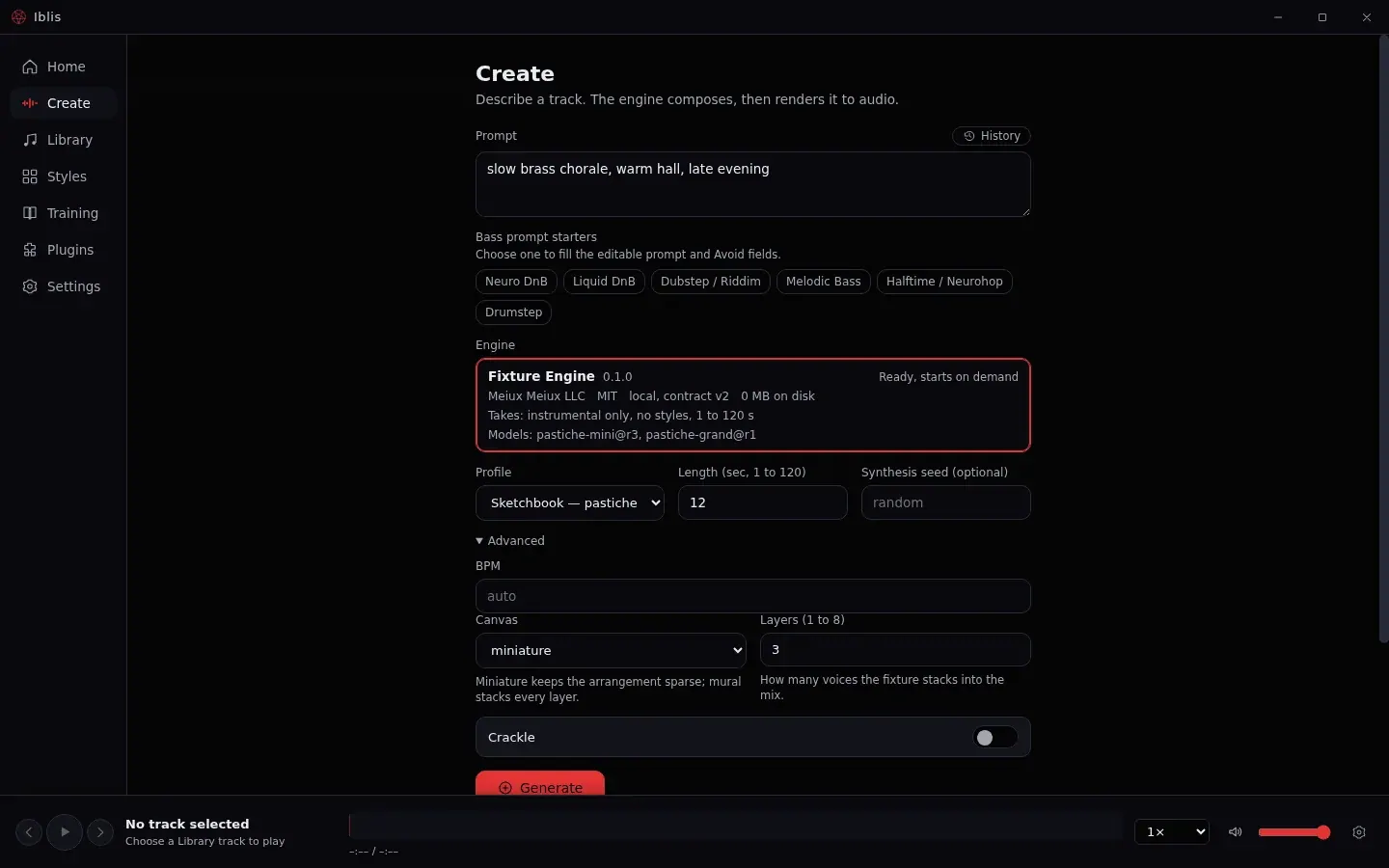
Real captures of the current alpha in the default Dark 3D skin, taken by
just screenshots against the test engine.
| Create | Library |
|---|---|
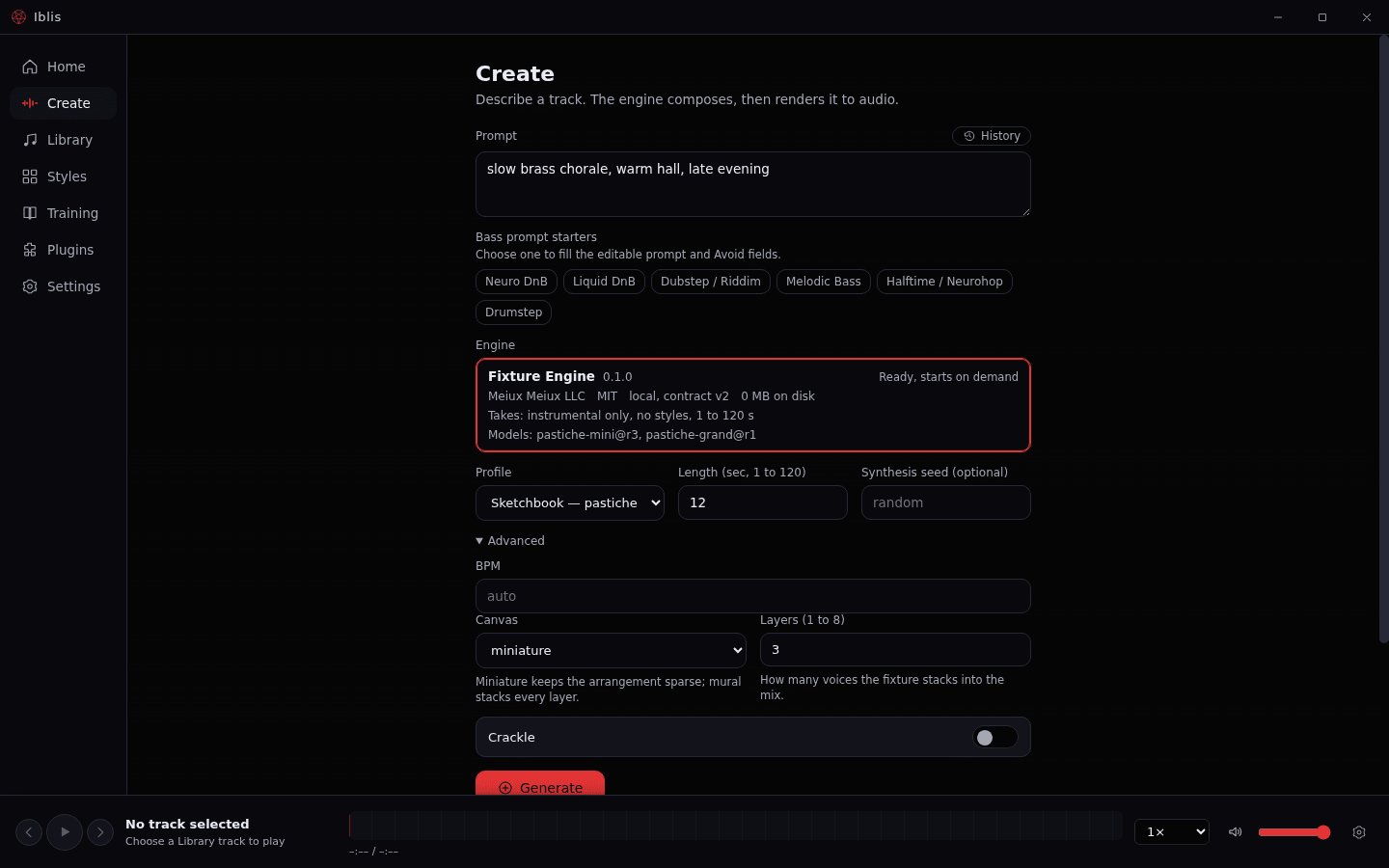 |
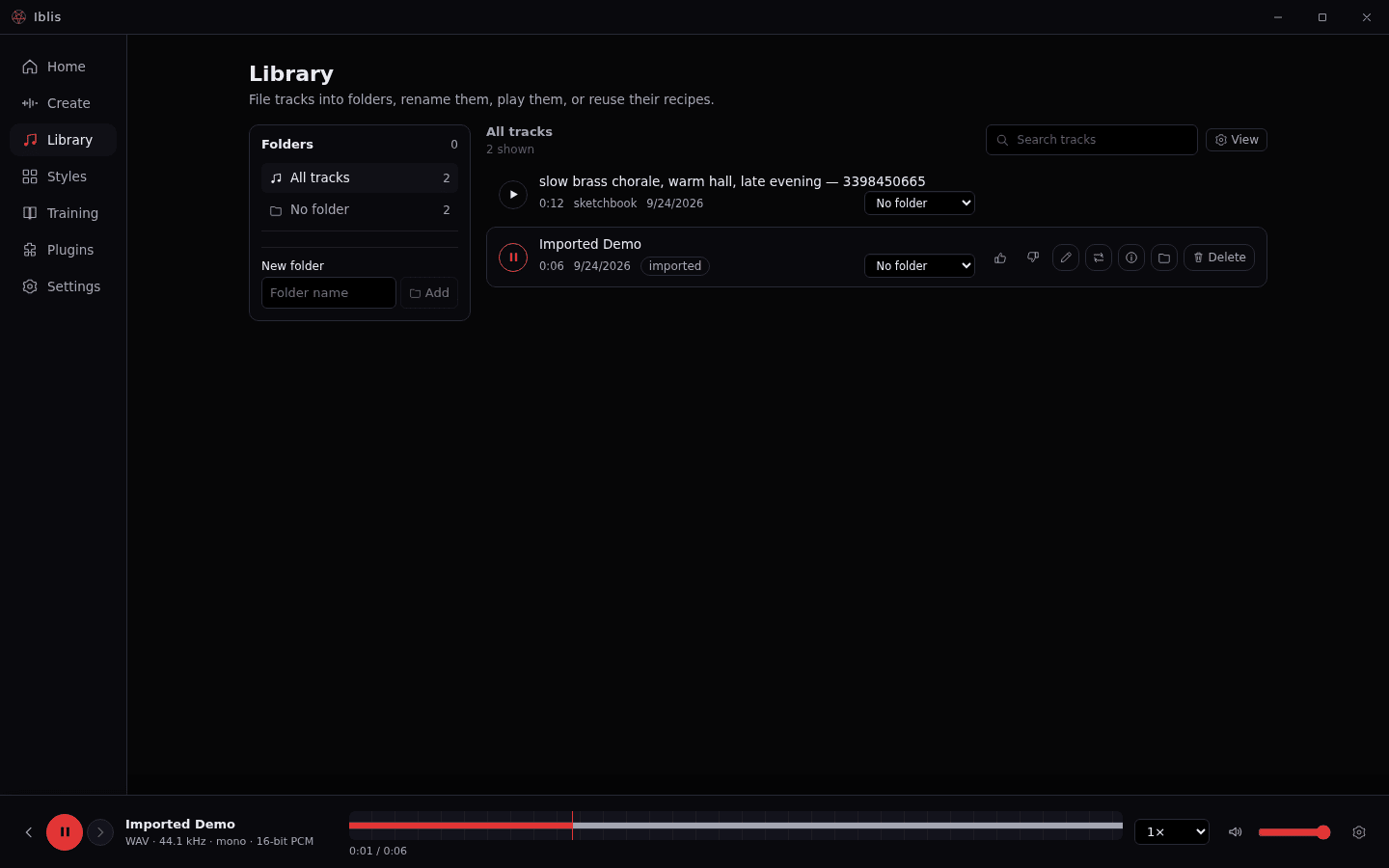 |
| Styles | Training |
|---|---|
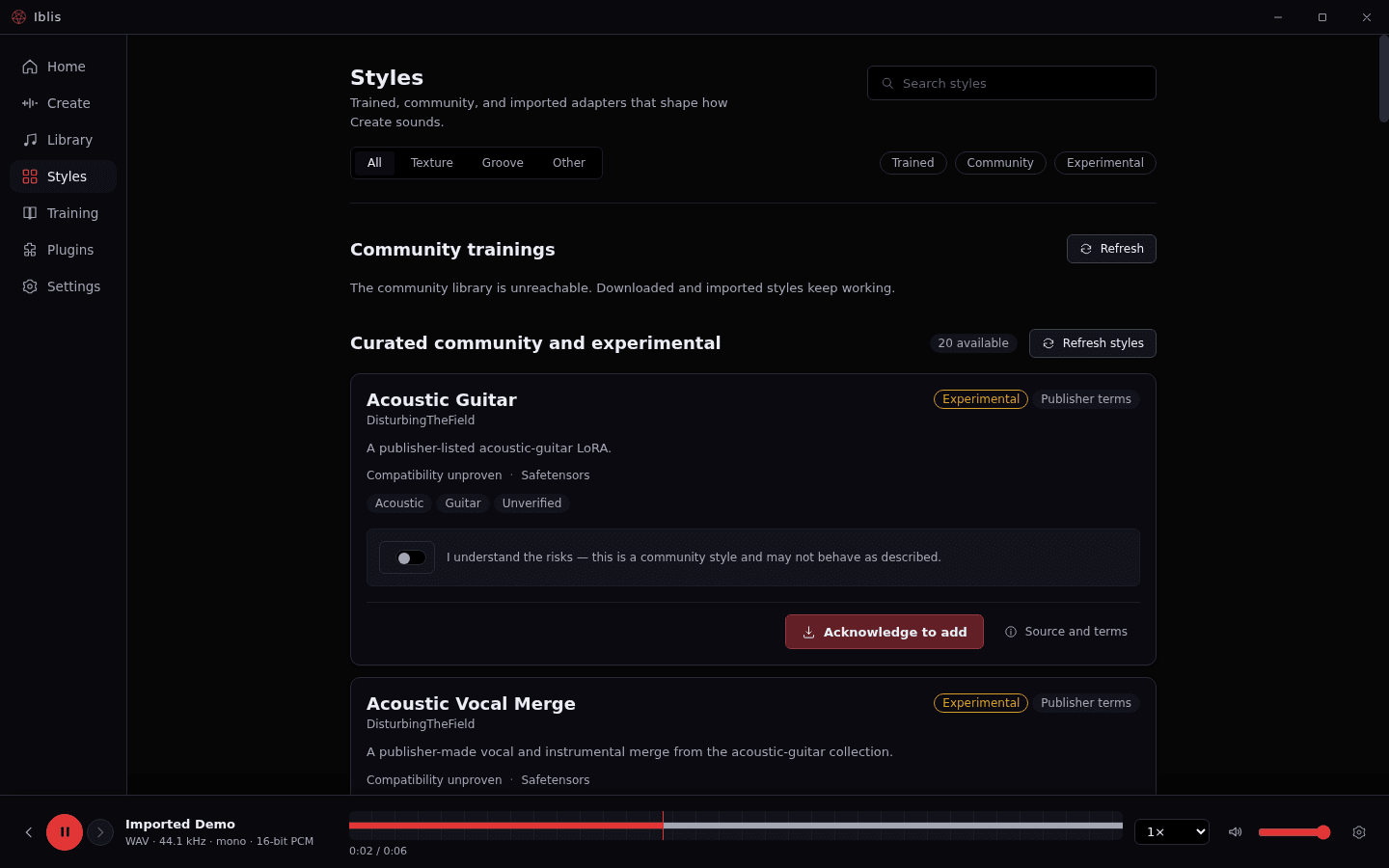 |
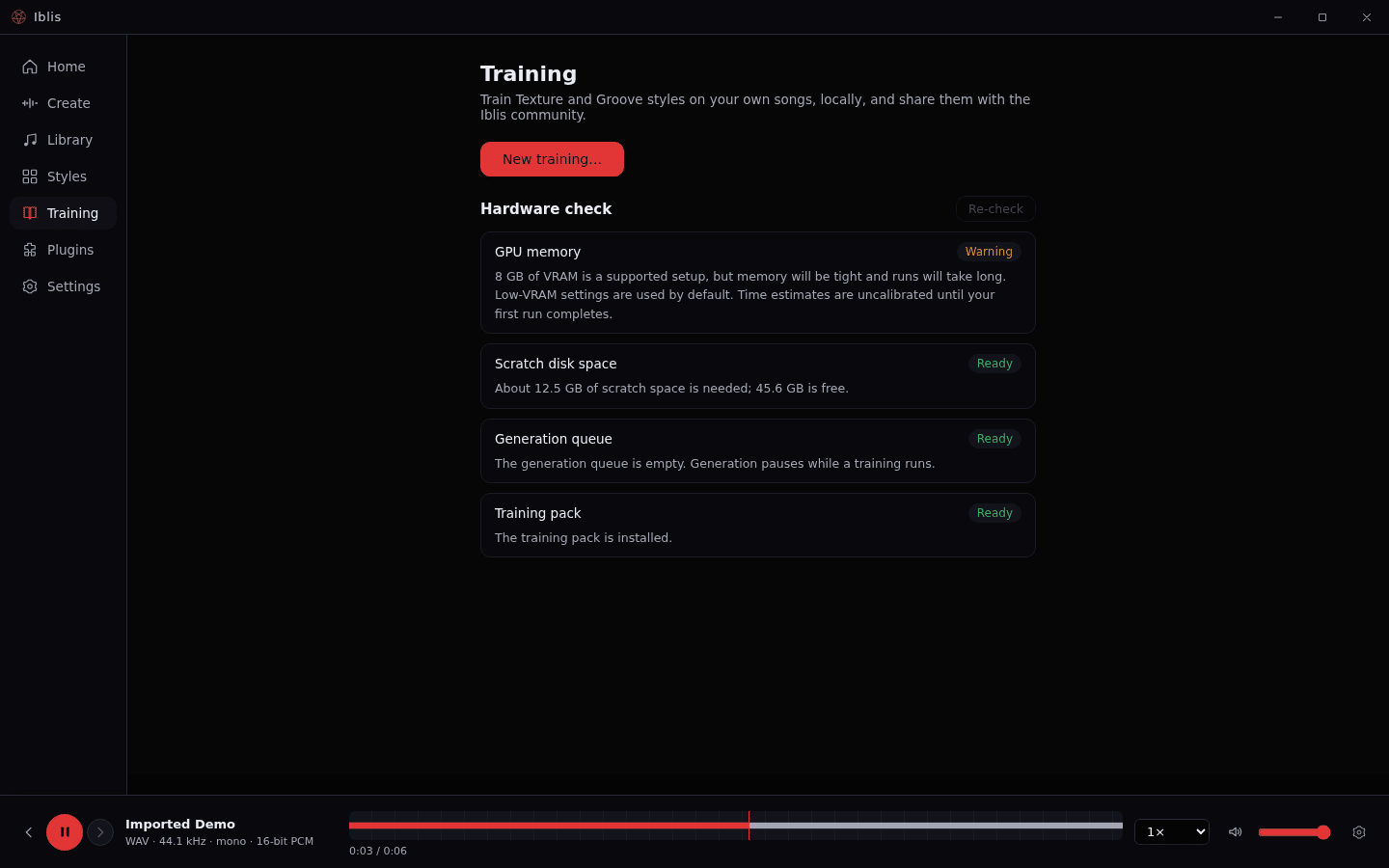 |
| Settings | Library in the Infernal skin |
|---|---|
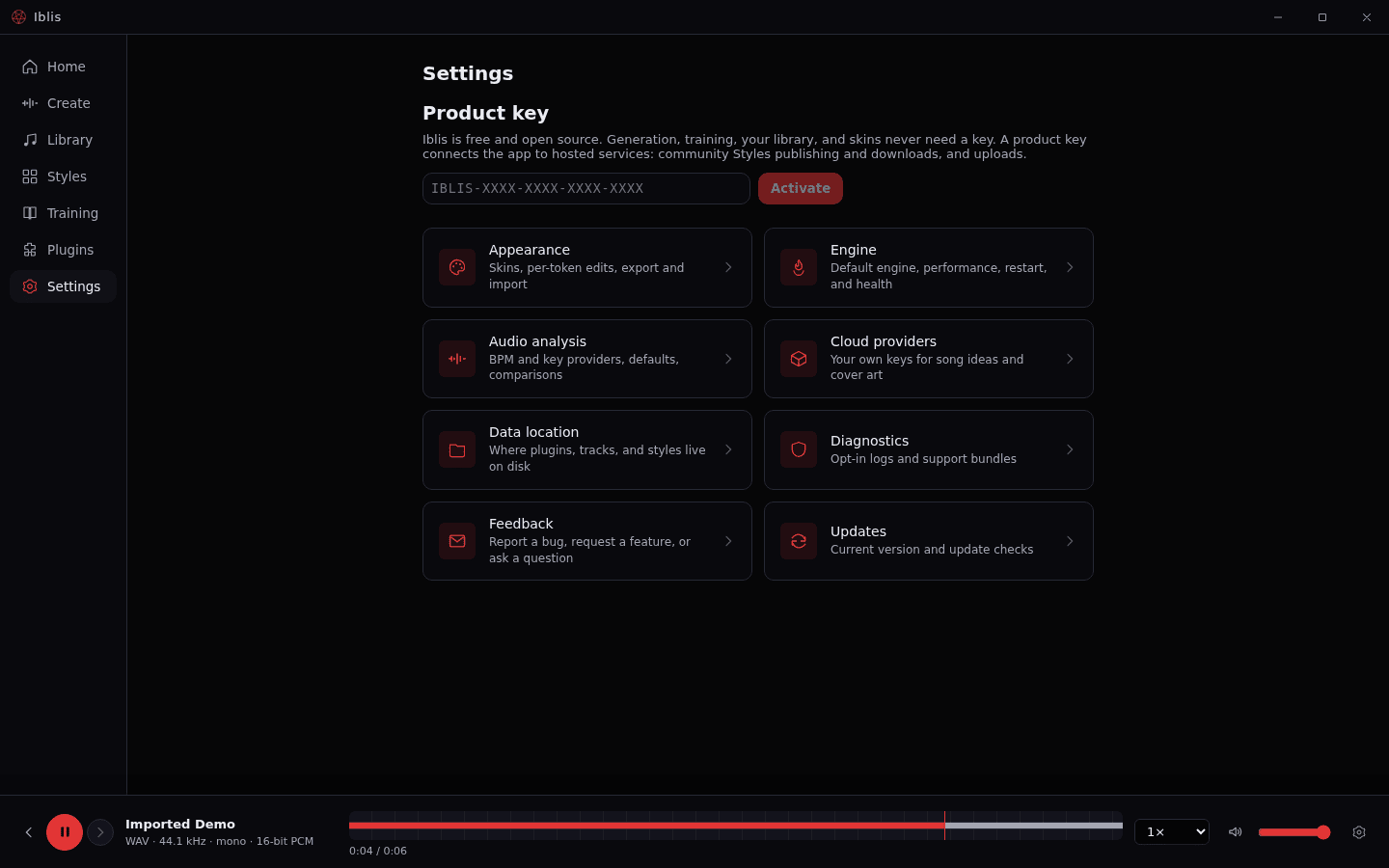 |
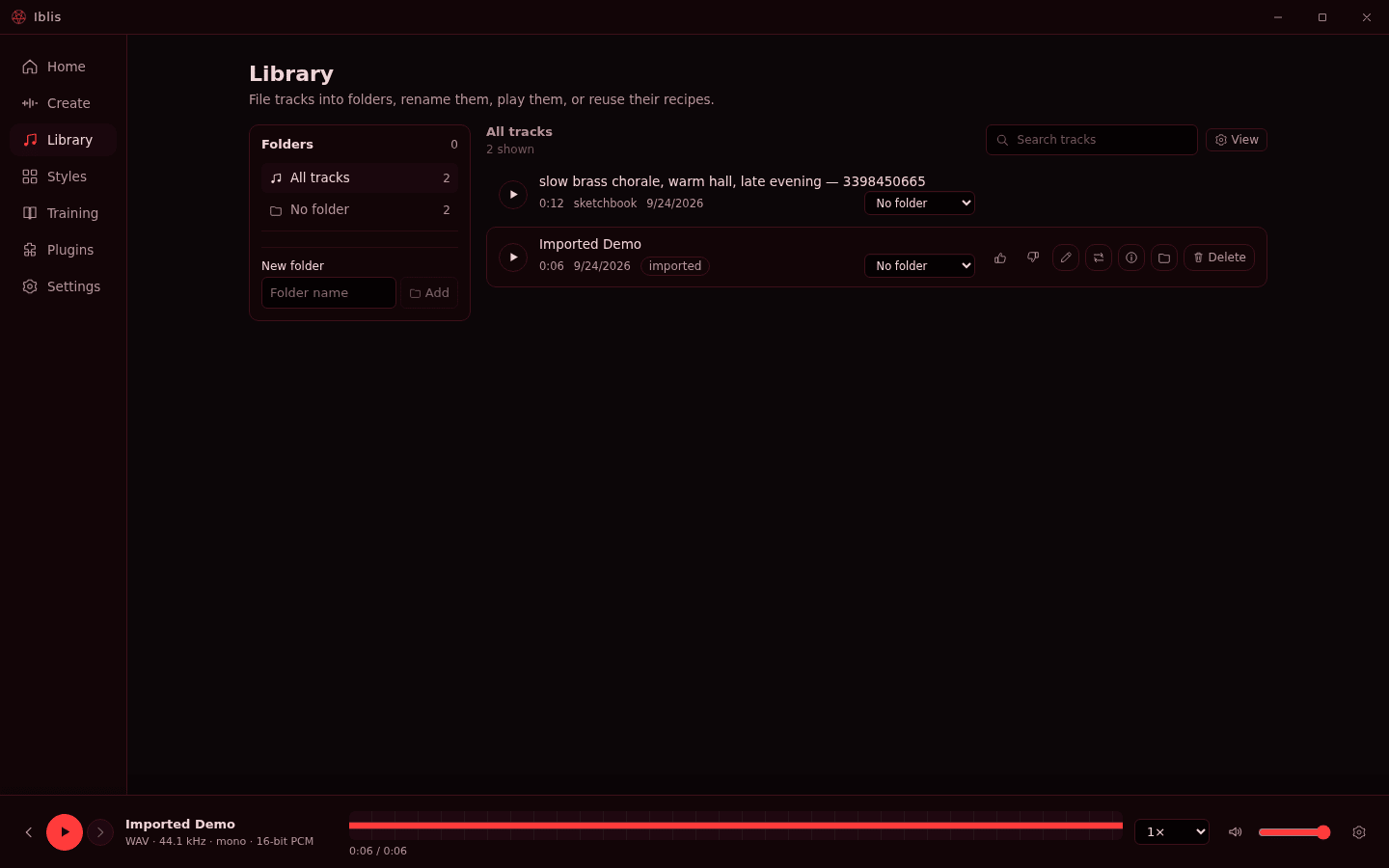 |
Features
- Generate. Text-to-music with ACE-Step 1.5 through
acestep.cpp. Prompt, optional lyrics, duration, and seeds; a serial queue that survives restarts, with Stop and Resume; blind A/B comparison of two settings. - Train your own Style. Point the Training section at a folder of your songs. The app separates stems, tags the audio, builds datasets, and trains a Texture and/or Groove LoRA locally. See docs/training.md.
- Styles library. Your trained and imported adapters, plus community Styles from a signed index. Pick one in Create and generate with it.
- Library, playback, analysis. Waveforms, levels, and built-in BPM and key detectors that run in a worker thread. Each detector shows its license.
- Plugins. Engines, processors, the trainer, cloud-provider adapters, and skins install from the signed catalog, update in place, and roll back. See docs/plugins.md.
- Skins. Every color, font, radius, and spacing value is a design token. Four built-in skins, an in-app token editor, and skins as plugins. See docs/skins.md.
Requirements
| Minimum | |
|---|---|
| OS | Windows 11, 64-bit |
| GPU (generation and training) | NVIDIA with 8 GB VRAM and a current driver |
| Disk | About 8 GB for the engine pack; the optional training pack is several GB more |
| Network | Only to download the app and plugin packs; generation and training run offline |
Install
Download the official installer from https://iblis.meiuxmeiux.com/download. Official builds are produced by the maintainers' release pipeline and update themselves: the app checks for a new version at launch and from Settings, Updates. On first run, Create offers to install the engine pack from the signed catalog.
Build from source
You need Node 24, pnpm, just, and Python 3.
The workspace pins the exact Node version in package.json (devEngines), and
pnpm downloads it for you. On Windows, run the recipes from a shell where Git
for Windows' sh.exe is on PATH.
just install      # workspace dependencies + the Electron binary
just dev          # open the app with hot reload (needs a desktop session)
just build        # bundle main, preload, and renderer into apps/shell/out/
just lint         # style scan, ESLint, Prettier, emoji scan
just typecheck    # svelte-check + TypeScript
just test         # unit tests in every package + the trainer sidecar tests
just e2e          # renderer E2E: Playwright over the built app (xvfb on Linux)
just dist         # unsigned Windows installer in apps/shell/release/ (on Windows)
just --list shows every recipe. docs/building.md covers
Windows and Linux setup, the E2E suite, and troubleshooting.
What a source build can do: everything the app does locally. It generates, trains, manages your library, and installs plugins from the same signed catalog as the official app.
What it cannot do: it is not code-signed, it does not auto-update, and Settings shows it as a Source build. It is not an official release, so the maintainers can only support it on a best-effort basis. docs/releases.md explains the difference, the status of the update-feed split, and how to match an official version to a public commit.
Architecture
+-------------------------- Iblis shell (Electron) ---------------------------+
|  Renderer (Svelte 5)                Main process                            |
|  Create, Library, Styles,   <--->   plugin host, catalog client, queue,     |
|  Training, Plugins, Settings  IPC   library store, updater, network owner   |
|  (no network, no paths)                     |                               |
+---------------------------------------------|-------------------------------+
                                              | spawn + HTTP on 127.0.0.1
                                              | (per-session secret header)
                        +---------------------+----------------------+
                        |                     |                      |
                  engine sidecar       training sidecar       processor sidecar
                  (acestep.cpp)        (embedded trainer)     (optional)

  Signed catalog (Ed25519) ---> main verifies ---> SHA-256-checked plugin assets
  Hosted services (product key) ---> community Styles, uploads
- The renderer never touches the network or the filesystem. It talks to the main process through typed IPC only.
- The main process owns the network, plugin installs, sidecar supervision, the generation queue, and the library.
- Sidecars bind to loopback only and refuse requests without the per-session secret. Engines speak the contract in docs/engine-contract.md.
- The signed catalog is the trust root for plugins. The public key ships in the app.
- Hosted services (key activation, community Styles publishing, uploads) run on the Iblis website. Their server code is not in this repository.
More in docs/architecture.md.
Plugin SDK quickstart
@iblis/plugin-sdk (Apache-2.0) holds the plugin contracts and their runtime
validators: PluginManifest, parseManifest, parseCatalog, the skin token
list (SKIN_TOKENS, parseSkinDescriptor), and the engine contract v2 types
and parsers (parseEngineDescriptorV2, parseEngineRecipeV2,
parseEngineJobStateV2). A minimal skin plugin manifest:
{
  "id": "com.example.skin.midnight",
  "name": "Midnight",
  "version": "1.0.0",
  "kind": "skin",
  "hostMinVersion": "0.2.0-alpha.43",
  "capabilities": [],
  "assets": [
    {
      "path": "skin.json",
      "sha256": "<64 lowercase hex characters>",
      "bytes": 812,
      "sources": [{ "kind": "vendor", "url": "https://example.com/midnight/1.0.0/skin.json" }]
    }
  ],
  "license": "MIT",
  "author": { "name": "Example" }
}
Validate it the way the shell does:
import { parseManifest } from '@iblis/plugin-sdk'

const result = parseManifest(JSON.parse(text))
if (!result.ok) console.error(result.errors.join('\n'))
just sdk-docs generates the API reference. Plugins reach users through the
signed catalog, which only the maintainers can sign; open an issue to propose
one. docs/plugins.md covers kinds, install layout, and
signature verification.
License
| Path | License |
|---|---|
apps/shell/ |
GPL-3.0-or-later (LICENSE) |
packages/plugin-sdk/ |
Apache-2.0 (packages/plugin-sdk/LICENSE) |
packages/plugins/*/ |
MIT (the license field of each manifest) |
scripts/, tools/, build configuration |
GPL-3.0-or-later |
contracts/ |
Apache-2.0 |
| Documentation | CC-BY-4.0 |
packages/brand/ |
All rights reserved (see TRADEMARKS.md) |
Every file carries an SPDX header or is covered by REUSE.toml; license texts are in LICENSES/. Third-party components and their licenses are listed in THIRD_PARTY_NOTICES.md. Model weights keep their own licenses; they are downloaded by plugin packs, not stored here.
Trademarks
"Iblis" and the Iblis logo are trademarks of Meiux Meiux LLC. The licenses above cover the code, not the name or logo. A fork must use its own name, icons, app id, and update feed. TRADEMARKS.md has the details.
Roadmap
What is shipped, what is next, and what is still only intent is kept in one place: https://iblis.meiuxmeiux.com/roadmap. It lists the unbuilt features by area with their current status, and it is updated with every release. Feature requests accepted from GitHub issues and the website's feedback form are folded into it.
Reporting bugs and asking questions
- GitHub issues for bugs, feature requests, and questions. The forms ask for your version, build type, GPU, and an optional diagnostics reference. Diagnostics are off by default; to get a reference, pick a level in Settings, Diagnostics and press Send diagnostics now.
- No GitHub account? Use the form at https://iblis.meiuxmeiux.com/feedback.
- Security issues: do not open a public issue. Follow SECURITY.md.
- Anything else: [email protected].
Contributions are welcome under the DCO; read CONTRIBUTING.md first. Project roles and decisions are in GOVERNANCE.md, and everyone here follows the Code of Conduct.
What is not in this repository
This repository is the open-source client. These parts stay private:
- Server code. The website, catalog hosting, product-key issuance and leases, community Styles ingest, diagnostics intake, and the admin panel.
- Signing. The catalog and lease private keys, and the tooling that uses
them. The matching public keys are in
apps/shell/electron/main/keys/. - Release pipeline. The CI that builds, signs, and publishes official installers and engine binaries, and uploads plugin assets.
- Internal documents. Planning notes, operational runbooks, and session history.
The public tree is exported from the maintainers' repository. Pull requests here are reviewed here, applied upstream with your authorship and sign-off, and come back in the next sync; see CONTRIBUTING.md.
Gallery
The full set.
Build something like this
Want a tool like this for your shop?
We've shipped this kind of thing before. Twenty-minute intro call, no slides.