

Chocobo Solar
Rooftop solar for poultry farms — a broiler house's long metal roof is the pitch, the power bill sets the size, and a struck coin in the mail turns into a callback.
Chocobo Solar is the public face of a rooftop-solar offer built for one kind of customer: broiler and layer farms in Georgia, South Carolina and Florida. A poultry house is a long, low, south-facing metal roof that the sun hits all day, and the site starts from that. It doesn't sell panels. It sells a free satellite snapshot of the farm's own roofs, sized to the farm's actual power bill rather than to how much roof there is, because load-matched is the sale that pencils. Four fields and a ZIP code, geocoded live as you type, start a lead: stored first, then the team is emailed, the grower gets a confirmation, and the record is forwarded straight into the sales team's CRM for routing. A second door opens from a physical coin — every coin in a direct-mail run carries a serial QR to its own redemption page, so a scan is logged even if nobody fills the form, and a redemption arrives tagged with the coin it came from. One static page with inline critical CSS, self-hosted fonts and no third-party scripts, a few PHP endpoints, SQLite, and a cartoon chicken in a hard hat.
- PHP
- SQLite
- MariaDB
- Vanilla JS
- Postmark
- Apache
- Let's Encrypt
- Playwright
- Lighthouse
- just
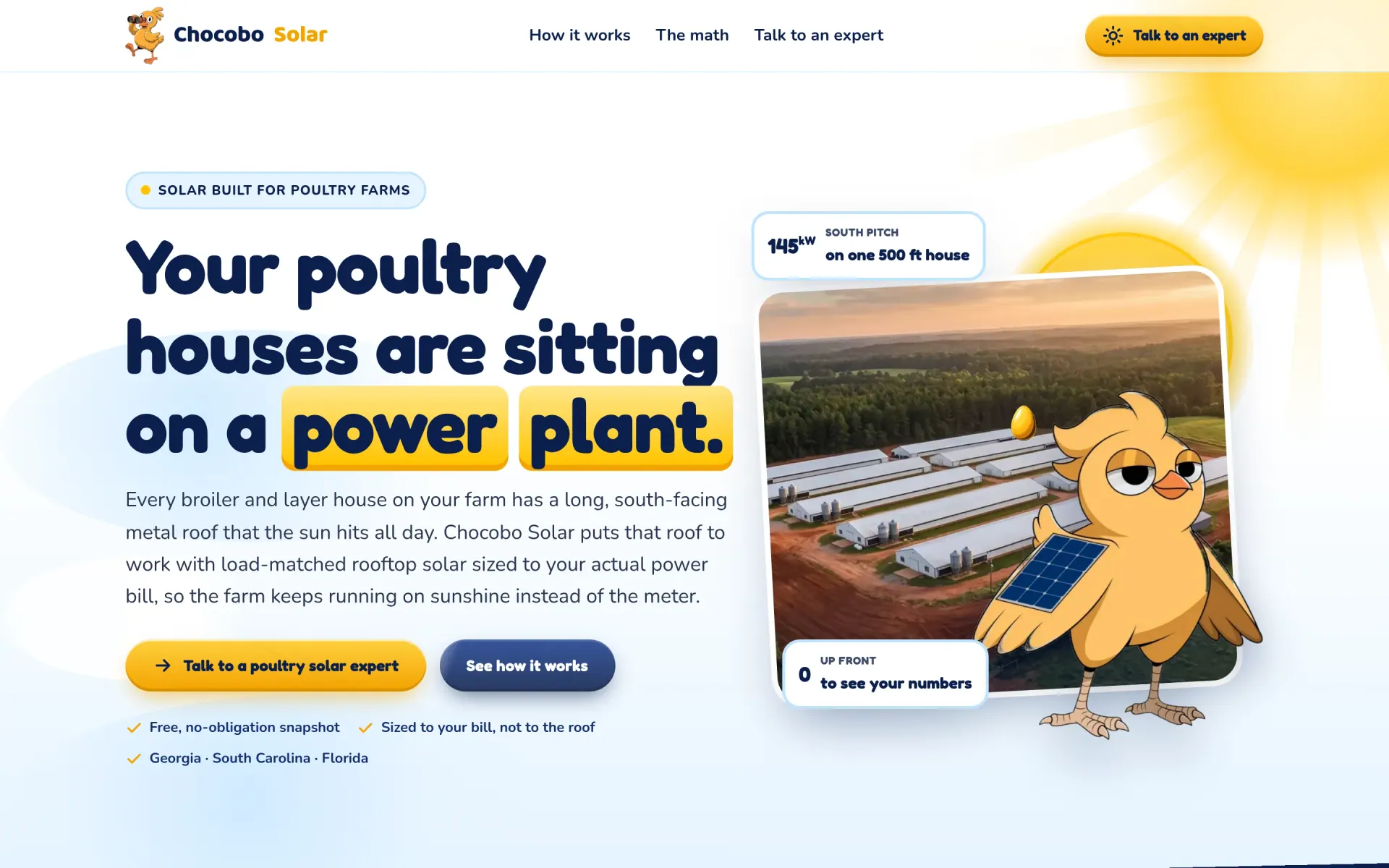


Chocobo Solar is a single-purpose brand site: rooftop solar for broiler and layer farms across Georgia, South Carolina and Florida, presented as its own brand with its own mascot, its own mailbox and its own funnel. The pitch is the roof. A poultry house is long, low and metal-roofed, which is exactly what solar wants, and the site's job is to turn that observation into a phone call from a grower.
From egg to energy in three steps
- Tell us about the farm — where it is, how many houses, and roughly what the power bill runs. Sixty seconds, no paperwork, no site visit.
- We scout the roofs — satellite imagery and a roof model say how much south-facing pitch there is and what it can produce.
- You get a real snapshot — system size, expected production and what it does to the bill, in plain numbers. Then the grower decides.
The math on one house
The site does the arithmetic in the open: a typical house runs about 500 feet, which is roughly 145 kW of south-facing pitch, against something like 46 kW worth of annual draw. So the honest sale is load-matched — a system sized to what the farm actually uses, so every panel pays for itself — and bigger only pencils as export or a power-purchase agreement, "and we'll tell you that honestly". Sizing to the bill rather than to the roof is the whole positioning, and the copy says so three times.
The funnel
- Four fields and a ZIP. The ZIP is looked up live as you type against a read-only geo table (one MariaDB user, SELECT on one table), so the form already knows the city, state and whether the farm is in the service area before it is submitted.
- Stored, then emailed, then forwarded. A lead lands in SQLite first — honeypot and per-IP limit in front of it — then the team is notified and the grower gets a confirmation through Postmark, then the record is signed and forwarded into the sales team's CRM, whose assignment rules pick the rep. An operator can re-send any lead's emails or re-forward it with one command.
- Inbound mail lands in the same database. hello@ is a Postmark inbound webhook into a mail table, not a mailbox somebody has to remember to check.
The coin
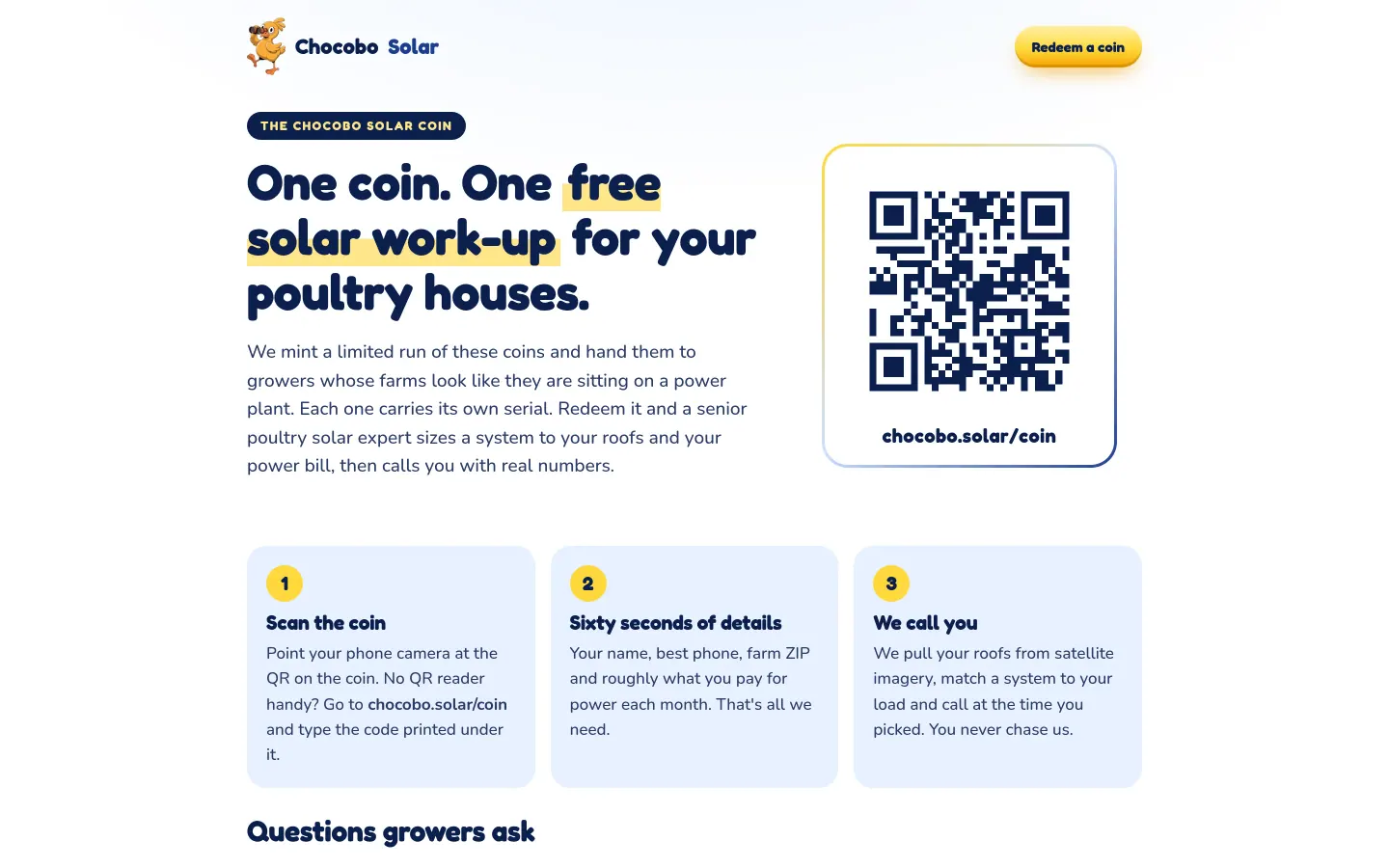
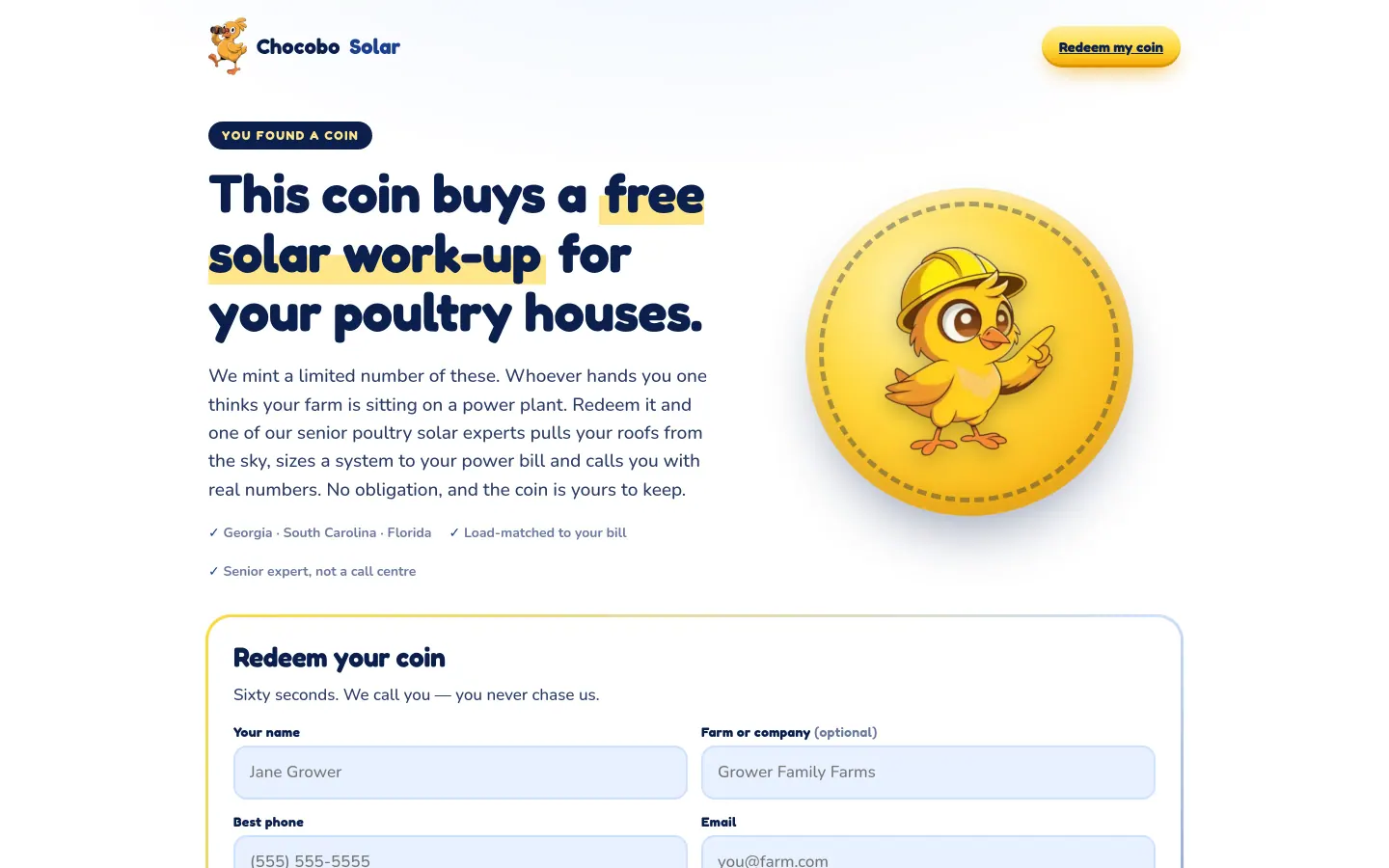
The second door is physical. A limited run of struck coins — minted
through Dubloons — goes out in
direct mail, each one carrying its own serial under a QR at
error-correction level Q. The QR opens /c/<CODE>,
and the scan is logged before any form is shown, so a coin that was
looked at but never redeemed still counts. A redemption arrives
tagged with the coin, batch and design it came from, and the mint
talks to a small Bearer-token API to register serials and read each
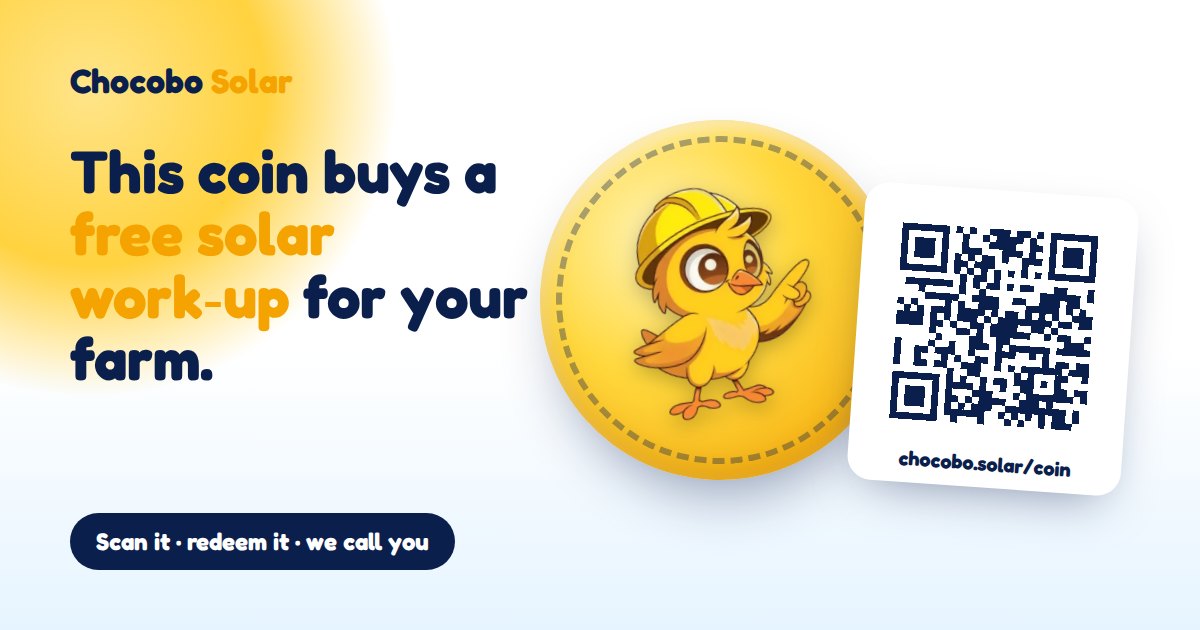
coin's scan and redeem status. A one-page Letter-size mailer insert
is rendered to PDF through Playwright from the same source as the
site, so the print piece and the page never drift.
House rules
- One static page. Inline critical CSS, self-hosted variable fonts, no third-party scripts, and a Lighthouse run after every change to it. The animated sky — a pulsing sun, drifting clouds, falling feathers — is pure CSS.
- Every form control is custom. No native
select, checkbox or radio; scrollbars are yellow on light blue
and never gray; light mode only; the palette is white,
#ffc400,#0b1f4dand#e6f4ff. - Boring infrastructure. Apache with a
Let's Encrypt certificate, PHP endpoints under
/api/, runtime secrets outside the web root, and the authoring tools — Playwright screenshots, the OG renderer, the QR generator, Lighthouse — never served.
Gallery
The full set.

Build something like this
Want a tool like this for your shop?
We've shipped this kind of thing before. Twenty-minute intro call, no slides.